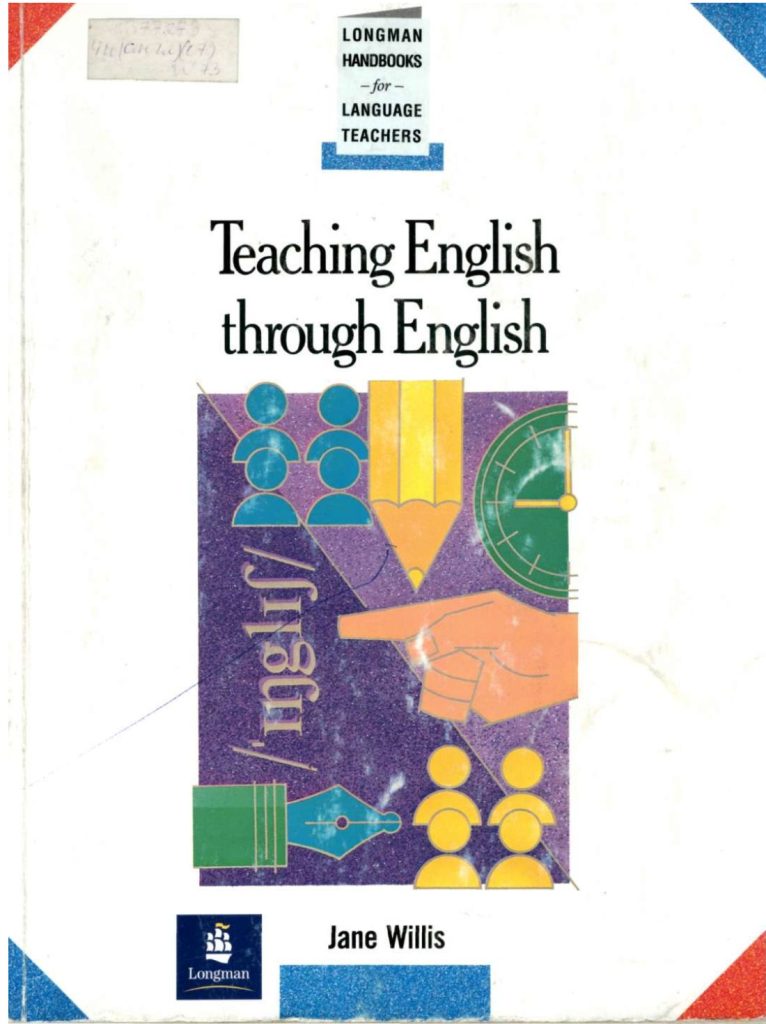
About This Book
Teaching English Through English Book is a teacher’s book about medium: teaching English through English, as its title states without decoration. The destination heading gives the exact title; the file served there, ‘Teaching English Through English.pdf’, carries the title minus the generic ‘Book’ — the same volume under the filename the site serves it by. The book’s work is conversion of the classroom’s operating language: moving the teacher’s instructions, routines, praise, and repair work into English, so the language being studied is also the language being heard all lesson long.
The argument begins with arithmetic. A student’s total exposure to English is, for most learners on earth, almost exactly the English lessons themselves — which makes the teacher’s choice of classroom language the single largest curriculum decision nobody lists as one. Every instruction translated is comprehensible input forgone; every routine conducted in English is a free daily lesson in listening, inference, and courage, repeated until the language of the classroom feels like weather rather than examination. The doctrine’s difficulty is equally concrete, and honest books in this line spend their craft on it: beginners cannot be flooded, they must be waded — the teacher’s English graded like a dimmer rather than a switch, slowed, gestured, repeated, and anchored to routines whose predictability carries meaning before vocabulary does. Classroom English is therefore a repertoire before it is a philosophy: the hundred stock phrases of opening, organising, checking, encouraging, and closing, drilled in the teacher until they are automatic, because a teacher composing management language on the spot will always retreat to the easier tongue. The place of the first language is the doctrine’s maturity test — banned as a medium, it survives as a tool: the occasional gloss for the abstract word, the quick check that an instruction landed, deployed like a scalpel rather than a crutch. What the approach buys, compounded over a school year, is the one asset translation-heavy teaching cannot counterfeit: students who have lived inside the language at low stakes for hundreds of hours, and who therefore meet the high-stakes uses — the conversation, the examination listening paper, the foreign colleague — as residents rather than tourists.
What Learners Will Practise
Graded Teacher Talk
Teachers practise pitching their English at the class’s water level — slower, clearer, gestured, repeated — comprehensible without being translated. The dimmer discipline is the doctrine’s core technique, and it is drilled, not assumed.
Routines in English
The book practises converting the day’s machinery — registers, instructions, transitions, praise — into stock English phrases used identically every lesson. Predictability carries the meaning until the words themselves are known.
The Scalpel Use of L1
Readers practise deploying the shared first language rarely and deliberately — a gloss, a check, a rescue — rather than as the lesson’s default medium. Restraint is a skill with rules, and the rules are rehearsed like everything else here.
Key Features
The medium doctrine is the feature: exposure arithmetic made into classroom policy, with the teacher’s own talk treated as the largest input source in the building. The graded-talk craft is the second — immersion without drowning, engineered — and the shelf fit the third, the medium manifesto beside this list’s rehearsed leadership and its general teaching craft. On this shelf it teaches in English here.
Who This Book Is For
Teachers of English in non-English-speaking classrooms are its first audience — the doctrine is addressed to their daily hundred decisions. Trainees and their trainers form its second readership, building classroom English before habits set. School leaders make its third, given the exposure audit that explains their graduates.
How to Use This Book
Convert routines first and content later: a fortnight of openings, instructions, and closings in English builds the platform before any explanation is attempted in the medium. Stock your phrases deliberately — write the twenty your classroom runs on, rehearse them aloud, and add five a month. Track the ratio honestly for a term; the doctrine’s promise is arithmetic, and arithmetic responds to measurement, not to intentions.
Related Books
The shelf’s rehearsed leadership stands at The Leadership Training Activity Book, and its general craft at How to Teach English Book.